
News - Tuesday October 6th, 2026
After the end
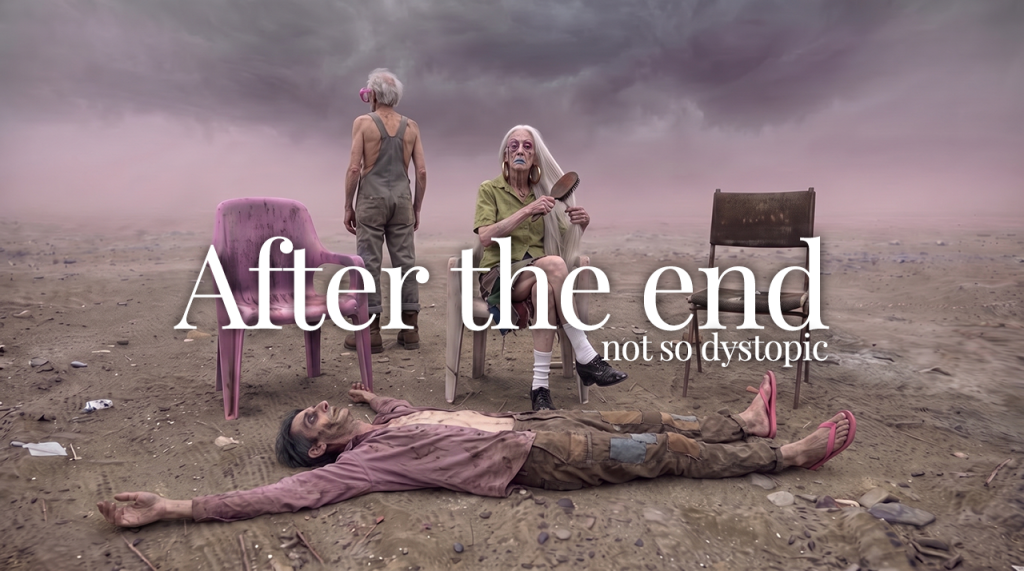
AFTER THE END is a form of catharsis, an attempt to cynically reflect on a current reality that feels like a science fiction movie. How it is still possible to wake up in the morning, read the newspapers, and smile is now an unanswered mystery. “After the end” is an artistic concept born from the urgency to express the fear, anger, and sense of helplessness I feel in the face of the continuous provocations of the bullies who, alas, hold power and are dragging us by the hair into a terrifying abyss.
AFTER THE END is a short-form dark comedy series set in an endless post-apocalyptic landscape where civilization has already collapsed, but human behavior has not. Three eccentric survivors sit on three chairs in an infinite limbo, a liminal space, a world now destroyed, vast, foggy, and desolate. They discuss ordinary things—money, power, war, climate, ownership, borders—as if nothing unusual had happened, aside from the already occurred extinction.
Their conversations are cynical and surreal, taking place in a future where the worst has already been done, a perspective that allows for a critique of the choices we ought to face in the present. No moral lessons, no explanations: just small observations that expose the absurdity, selfishness, and stupidity that helped destroy the world. The end of civilization is treated as a mere ordinary inconvenience, filled with long silences, deadpan performances, cynicism, dark humor, and a healthy dose of ruthlessness.
The world is gone. Human nature isn’t.
Technical Notes
The series is entirely produced by exploring the most advanced AI video generation technologies, in an attempt to bend the algorithm to a rigid, stripped-back, and photographic directorial vision—yet one that remains non-realistic and decidedly caricatured. The tools used vary depending on the specific needs of the scene: this project is intended as a true work in progress that will evolve and improve hand in hand with the technological advancement itself. My preference has always been for open-source tools capable of running locally on a personal computer, avoiding dependence on massive external data centers and thus ensuring a reduced environmental footprint in terms of CO2 emissions. Today, unfortunately, not all of the most complex generative models can be run on a standard workstation, no matter how powerful and professional it may be. Consequently, the optimal use of these technologies remains limited to a narrow niche of the production landscape. However, everything is moving at a staggering, unprecedented speed, so I am confident in the rapid development of local models by the open-source community.